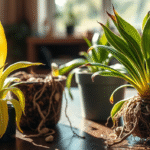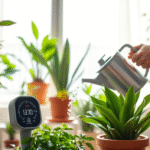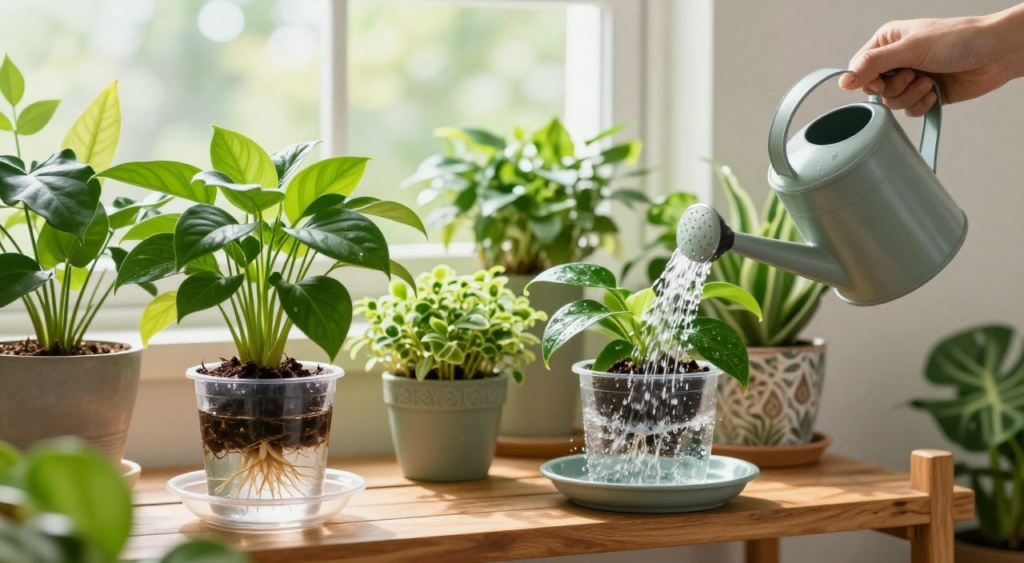
Top watering is the “classic” method. Bottom watering (soaking from below) is the “control the moisture and keep foliage dry” method. Both are valid—the best watering method for houseplants is the one that matches your plant, potting mix, and your home’s drying speed.
This guide breaks down bottom watering vs top watering with practical steps, a simple decision chart, and the few situations where one method clearly beats the other.
Quick answer: which method should you use?
| If you have… | Use this more often | Why |
|---|---|---|
| Plants prone to crown/leaf issues (e.g., African violets) | Bottom watering | Keeps water off sensitive crowns/leaves and reduces spotting risk (NC State Extension) |
| Very fast-draining chunky mixes (orchid bark, aroid mix) | Top watering (or soak-and-drain) | Water moves through quickly and helps rinse old salts |
| Fungus gnat problems + consistently damp surface soil | Bottom watering + let top dry | Gnats like moist surfaces; letting the top layer dry helps disrupt them (Extension.org) |
| White crust on soil/pot rim (salt buildup) | Top watering occasionally | Leaching (watering until it drains well) helps flush soluble salts from containers (University of Illinois Extension) |
| You’re often busy and want fewer “oops” overwatering moments | Bottom watering (with a timer) | Gives you a clear start/stop point: soak, then remove and drain |
The critical role of proper watering for houseplant health
Watering is not only about “how often.” It’s about how evenly the root zone gets wet, how quickly extra water can escape, and whether you’re accidentally creating problems (stagnant soggy soil, salt buildup, wet crowns, or bone-dry pockets).
Common signs your method (not just your schedule) is off
| What you see | Usually means | Fix |
|---|---|---|
| Yellow leaves + soft stems + soil smells “swampy” | Overwatering / low oxygen at roots | Let soil dry, improve drainage, shorten soak time (bottom) or water slower (top) |
| Wilting + crispy leaf edges + soil pulls from pot | Underwatering / dry pockets | Soak-and-drain once, then return to a steady method |
| White crust on soil/pot rim | Soluble salt buildup | Leach with top watering until it drains well; repeat occasionally (University of Illinois Extension) |
| Fungus gnats hovering + constantly wet surface | Surface staying too moist | Let top layer dry more; consider bottom watering (Extension.org) |
Top watering explained
Top watering means pouring water onto the soil surface until the root zone is fully moistened and excess drains out the bottom. This is also the easiest way to leach accumulated salts from potting mix when needed (University of Illinois Extension).
Top watering: best practice (the “no regret” version)
- Check first: lift the pot (light = drier) and feel the top 2–3 cm of soil. Don’t water just because it’s “watering day.”
- Water slowly over the soil surface (avoid blasting the mix and compacting it).
- Water until it drains from the bottom. That confirms the full root zone got wet and helps reduce dry pockets.
- Empty the saucer after 5–10 minutes. Don’t let pots sit in runoff long-term.
- Monthly (or every 6–8 weeks): do a “flush watering” (more water than usual, good drainage) if you see crusty salts or use fertilizer regularly (University of Illinois Extension).
Top watering is usually best for
- Most “standard” houseplants in well-draining potting mix
- Plants in chunky mixes (aroids, orchids) where water needs to move through quickly
- Anyone who wants an easy routine plus occasional salt flushing
Bottom watering explained
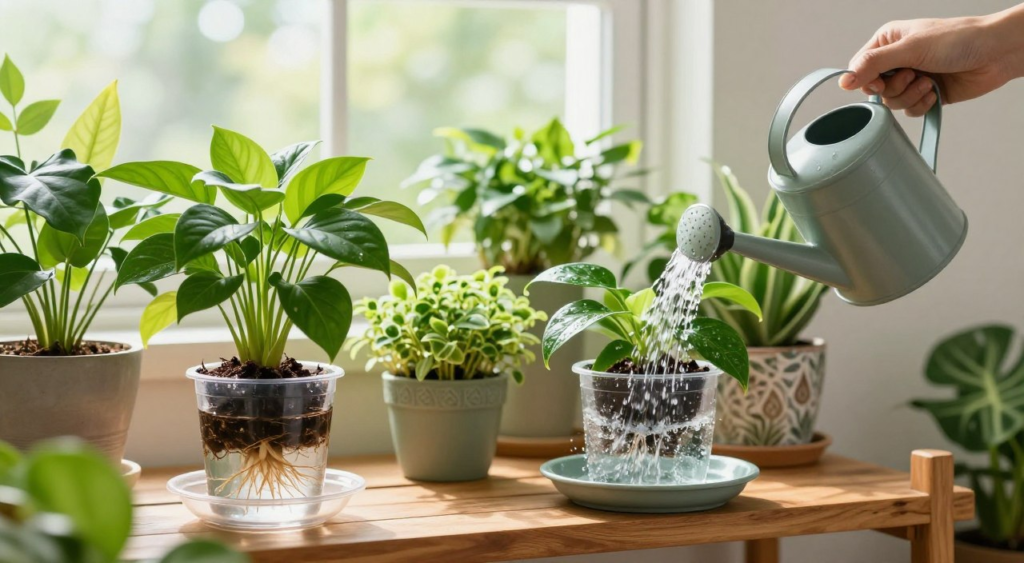
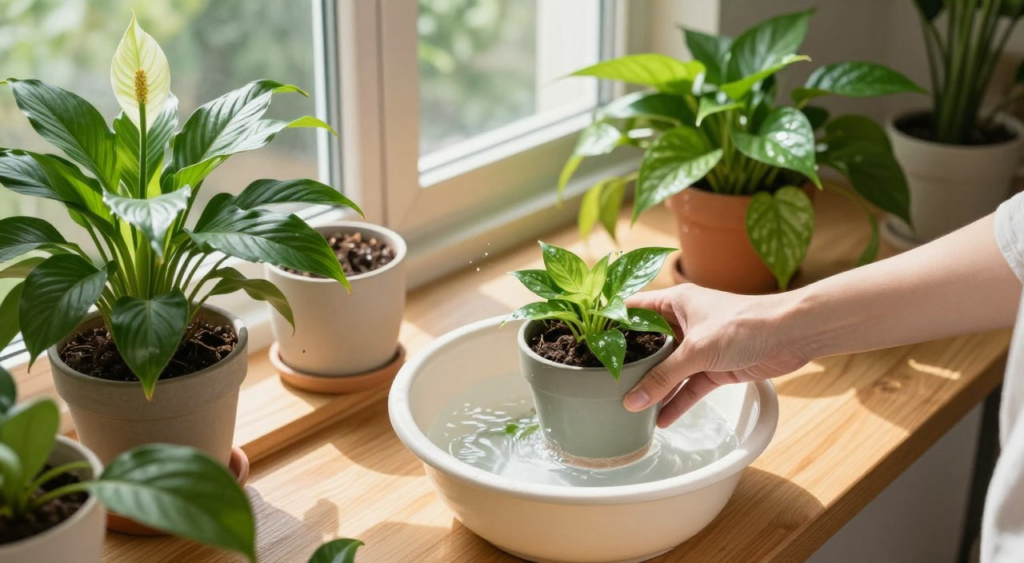
Bottom watering means setting the pot into a shallow tray of water and letting the mix wick moisture upward through the drainage holes. It can be excellent for plants that dislike wet foliage/crowns, and it can help keep the soil surface drier (useful if fungus gnats are an issue) (NC State Extension; Extension.org).
Bottom watering: best practice (simple and clean)
- Use a clean tray/basin. Add water to about 2–4 cm depth (enough to contact drainage holes).
- Place the pot in the tray and set a timer.
- Soak time: 10–15 minutes for small pots (8–12 cm), 20–30 minutes for medium pots (13–18 cm), up to 45 minutes for larger pots if the mix was very dry.
- Remove the pot when the top of the mix feels evenly damp (not muddy). Let it drain for a minute, then return it to its spot.
- Do not leave standing water under the pot for hours. That turns bottom watering into “permanent sogginess.”
Bottom watering is usually best for
- African violets and other plants that prefer avoiding water on the crown/leaves (NC State Extension)
- Plants that easily develop dry pockets (tight root balls, hydrophobic peat-based mixes)
- Homes with fungus gnat pressure (as part of a full strategy that also allows the surface to dry) (Extension.org)
Bottom watering vs top watering: the real differences that matter
1) Moisture distribution
Top watering can miss dry pockets if you water too fast or if the mix is very dry and repels water. Bottom watering is often better at rehydrating a dry root ball because moisture moves in more gradually.
2) Salt buildup (big one people ignore)
When you fertilize or use mineral-heavy water, soluble salts can accumulate in containers. Leaching (watering so excess drains out) is a common recommendation to reduce salt buildup (University of Illinois Extension). If you bottom water every time, those salts can remain in the pot longer because you’re not routinely flushing the full profile.
Practical rule: if you mainly bottom water, top water occasionally (for example, every 4–6 weeks) until you get good drainage. That gives you the best of both worlds.
3) Pest and disease pressure
Keeping the soil surface constantly wet can encourage fungus gnats. Letting the surface dry more between waterings is a common management step (Extension.org). Bottom watering can help with that if you also avoid over-soaking and you don’t leave standing water beneath the pot.
4) Time and mess
Top watering is faster. Bottom watering is cleaner for foliage and can be more controlled, but it takes more time per session unless you batch-water multiple pots in a basin.
Plant-by-plant guidance (simple and realistic)
| Plant group | Usually easiest method | Notes |
|---|---|---|
| African violets | Bottom watering | Avoid wetting crown/leaves; reduces spotting risk (NC State Extension) |
| Succulents & cacti | Top watering (thorough, then dry) | Either can work; key is letting mix dry and never leaving a pot sitting in water |
| Ferns, peace lily, many tropical foliage plants | Top or bottom | Choose the method that keeps moisture steady without waterlogging; avoid soaking too long |
| Plants with fungus gnat issues | Bottom watering + surface dry | Reduce consistently wet surface conditions (Extension.org) |
| Orchids / very chunky mixes | Top watering (or soak-and-drain) | Water should move through freely; don’t keep bark constantly wet |
A safe “hybrid” routine that works for most homes
If you want one routine that covers most houseplants without drama:
- Default: top water slowly until drainage, then empty saucers
- Use bottom watering: for sensitive crowns (like African violets) or when a pot has become hydrophobic and won’t absorb from the top
- Monthly flush: top water extra thoroughly (good drainage) if you fertilize or see salt crust (University of Illinois Extension)
Water quality: quick myth check (to avoid silent problems)
Myth: “Let tap water sit overnight and everything bad disappears.”
Reality: Some systems disinfect with chloramine, which is more stable and lasts longer in distribution systems than free chlorine (US EPA). So “letting it sit” may not change much if chloramine is used. Also, boiling water does not remove chemical contaminants and can concentrate some of them (Idaho DEQ).
Practical advice: if you suspect water sensitivity (brown tips, crusty salts, repeated issues), try filtered water or rainwater for a few weeks and compare results. The goal is consistency, not perfection.
Troubleshooting common watering problems
If you keep overwatering
- Switch to a pot with real drainage holes (no exceptions)
- Shorten bottom-watering soak times and always drain afterward
- Use a chunkier mix or add aeration (perlite/bark) so roots get oxygen
If your soil dries into hard, water-repelling pockets
- Do one bottom-watering “reset soak” to rehydrate evenly
- Then return to slow top watering (or repeat bottom watering as needed)
- Consider repotting if the mix is old and breaking down
If you get fungus gnats again and again
Don’t chase gadgets first. Fix the moisture pattern: let the top layer dry more between watering cycles and avoid standing water. Fungus gnats are strongly linked with persistently moist potting media surfaces (Extension.org).
Conclusion
Top watering is fast, simple, and great for routine care and occasional salt flushing. Bottom watering is controlled, keeps foliage/crowns drier, and can help when the surface staying wet causes problems.
If you want the most “approval-safe” advice for real plant results: use both methods intentionally. Pick the one that fits the plant and pot, and keep one non-negotiable rule: excellent drainage and no standing water.
FAQ
Q: Is bottom watering better than top watering?
A: Not universally. Bottom watering is great for certain plants (like African violets) and for controlling wet crowns/leaves (NC State Extension). Top watering is often better for routine watering and flushing salts.
Q: How long should I bottom water my plants?
A: Usually 10–30 minutes depending on pot size and how dry the mix is. Remove the pot when the top feels evenly damp, then let it drain. Avoid leaving pots sitting in water for hours.
Q: Will bottom watering cause salt buildup?
A: It can if you never flush the pot. Do an occasional top-water “leach” (water until it drains well) to reduce salt accumulation, especially if you fertilize (University of Illinois Extension).
Q: Does letting tap water sit overnight make it safe for plants?
A: Not always. Some water systems use chloramine, which is more stable and lasts longer than free chlorine (US EPA). Boiling also doesn’t remove chemical contaminants and can concentrate some (Idaho DEQ).
Q: Can bottom watering help with fungus gnats?
A: It can help if it keeps the soil surface drier, but the key is not keeping the top layer constantly wet. Drying the surface more between watering cycles is a common control step (Extension.org).
About the author
Mohammed Zandar (yup.work90) writes practical indoor-plant guides focused on clear steps, real-world troubleshooting, and simple routines that help beginners keep houseplants healthy without guesswork.