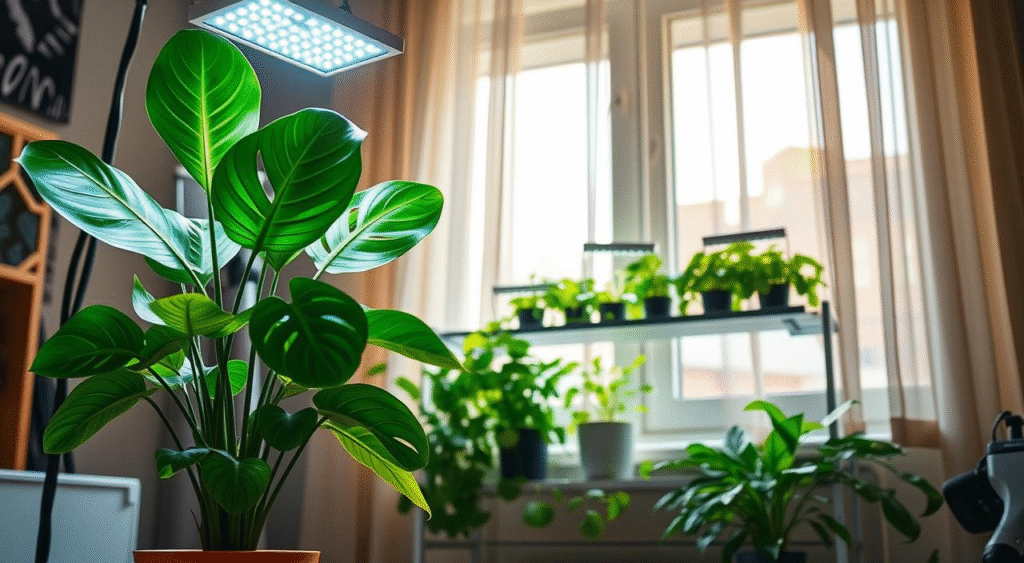
If you live in an apartment, you already know the problem: plants make a space feel calmer and more “alive,” but the light often isn’t. North-facing rooms, deep floorplans, balconies shaded by other buildings—your plants can survive, but they rarely thrive.
A grow light is simply a way to “buy back” the light your windows can’t deliver consistently—especially in winter or in darker corners. The trick is not to overcomplicate it. For most apartment plant setups, you only need to get three things right: intensity (how bright at leaf level), color (Kelvin/spectrum), and timing (hours on a timer).
This guide keeps it practical: how to use lumens (and the better metric called foot-candles), what Kelvin actually changes, and how to set timers so your plants get reliable day/night cycles.
Start Here: A “Good Enough” Grow Light Setup for Most Apartments
- Light type: LED grow light (bar, panel, or bulb) to keep heat and power use low. The RHS notes LEDs are efficient and run cool compared with older HID systems. RHS
- Kelvin: Choose a white “daylight/neutral” option around 4000K–6500K if you want it to look normal in a living space. RHS
- Timer: Set 12–14 hours/day for most foliage houseplants; don’t run lights 24/7. University of Minnesota Extension University of Maryland Extension
- Distance: Start around 30–45 cm (12–18 in) above the plant canopy for small LED bars/panels, then adjust based on plant response (more on this below).
That setup covers the majority of apartment plant collections (pothos, philodendron, monstera, snake plant, dracaena, etc.). Once you see plants respond, you can fine-tune intensity and hours.
Why Apartment Plants Often Need Supplemental Lighting
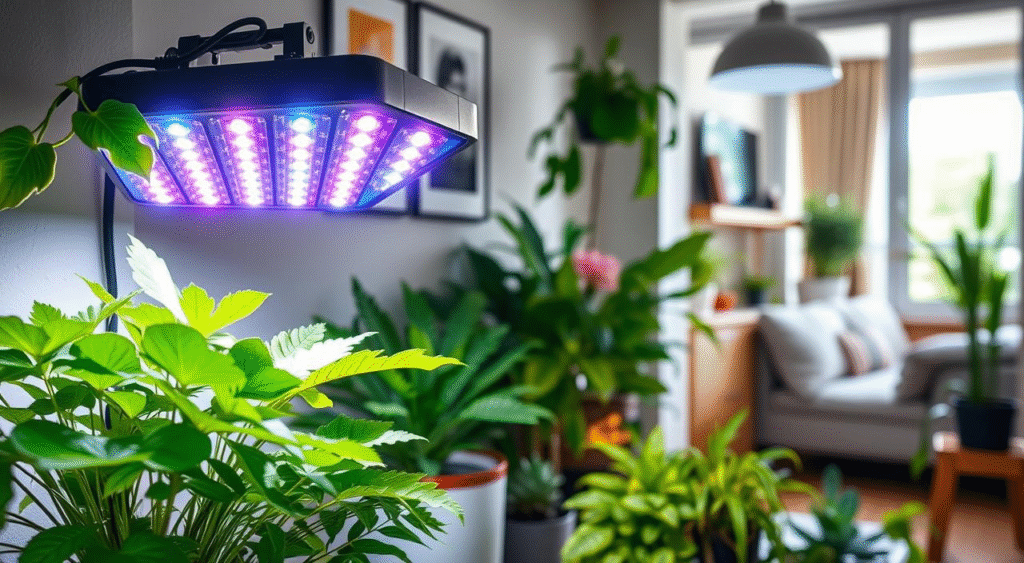
Indoors, even a “bright” room is usually dim compared with outdoor daylight. Light gets weaker fast as you move away from windows, and surrounding buildings can cut it further. Extension guides list common signs of low light: stretched growth (leggy stems), smaller leaves, pale foliage, slow growth, and leaves dropping over time. UF/IFAS University of Maryland Extension
Grow lights don’t need to replace sunlight completely. In apartments, they’re often best used to:
- support plants on shelves/corners that never get window light
- boost growth during winter’s shorter days
- keep herbs compact and productive instead of tall and weak
Grow Light Basics: What Matters (and What’s Just Marketing)
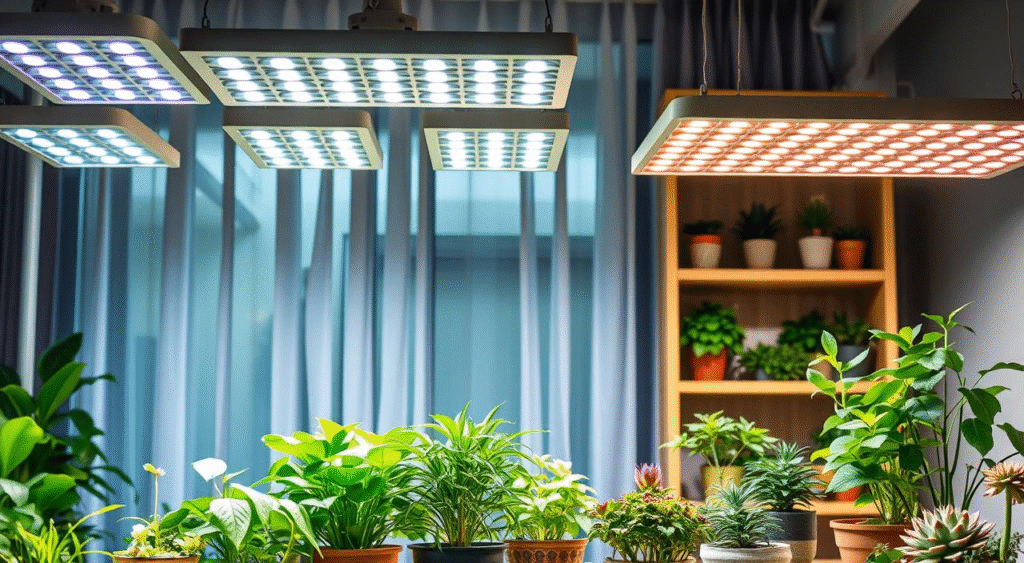
Intensity: the #1 reason grow light setups fail
For plants, “bright enough” is about the light reaching the leaf surface—not what looks bright to your eyes across the room. That’s why two bulbs with the same “lumens” can perform very differently depending on distance, angle, reflectors, and how wide the light spreads.
If a grow light brand provides a PPFD map (a plant-focused intensity map), use that. PPFD is a standard plant-light measurement (photosynthetic photons hitting a surface each second). Resource Innovation Institute
If you’re shopping basic apartment grow lights that only list lumens, don’t panic—just use lumens the right way (next section).
Spectrum and Kelvin: useful, but secondary to intensity
Plants use mostly red and blue parts of light for growth and flowering; “white” grow lights are basically a balanced mix that still supports photosynthesis. University of Minnesota Extension The RHS also notes that lights can be described on the Kelvin (K) scale and that different Kelvin values look more reddish or more bluish. RHS
Timing: plants need a dark period
Most houseplants do better with consistent light schedules and a real night period. The University of Maryland Extension specifically notes most plants need darkness and recommends not exceeding about 16 total hours of light per day (especially if combining window light with artificial light). University of Maryland Extension
Lumens (and the Better Shortcut): Use Foot-Candles at Leaf Level
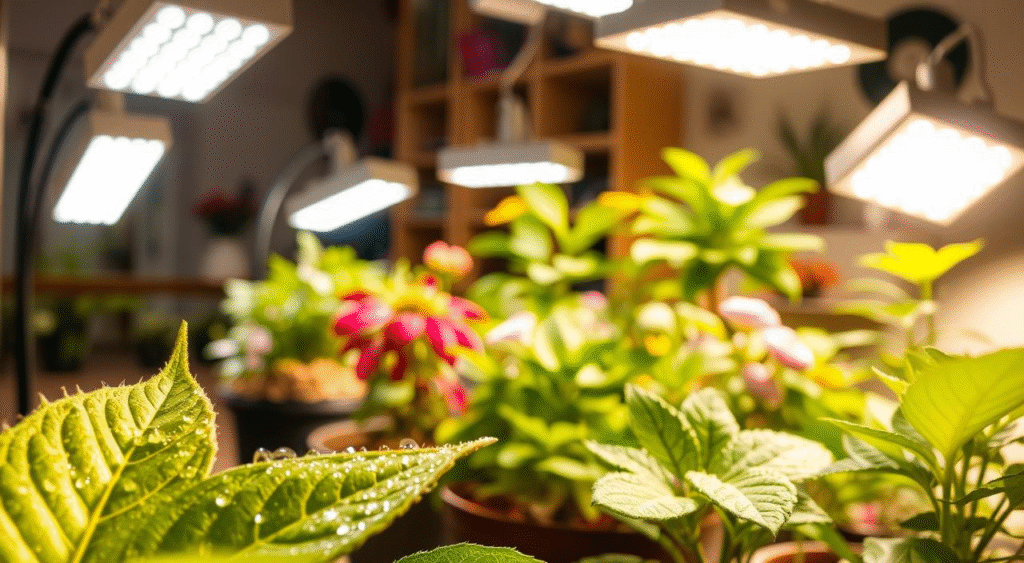
Lumens are the total visible light a lamp produces. For plants, what you actually want is intensity at the plant canopy. A very practical bridge metric is foot-candles (fc), which many horticulture references use for indoor plants.
Here are useful indoor plant light ranges (measured at the plant) from major extension references:
| Light level at leaves | Foot-candles (fc) | Typical apartment examples |
|---|---|---|
| Low light | 25–100 fc | North window, interior rooms with lamps |
| Medium-bright light | 100–500 fc | East/west windows, brighter interiors |
| High light | 500–1000 fc | South window zones, strong supplemental light |
Sources: University of Maryland Extension and houseplant lighting guidance from University of Missouri Extension.
The easiest apartment method: use a phone lux meter (as a rough tool)
Many people use a free lux-meter app to compare spots in the apartment (it won’t be lab-accurate, but it’s useful for “brighter vs dimmer”). Measure at the top leaves where the plant actually receives light. If the app reads in lux, you can roughly convert to foot-candles by dividing by 10.8 (since 1 fc ≈ 10.8 lux).
Then adjust only one variable at a time:
- Move the light closer/farther (distance changes intensity fast).
- Increase/decrease daily hours (timer).
- Only then consider changing the light itself (more output, different spread).
Kelvin Explained: What to Buy So Plants Grow and Your Room Still Looks Normal
Kelvin (K) describes how “warm” or “cool” a white light looks. It’s not a perfect plant metric, but it’s a helpful shopping shortcut for apartment growers who want lights that don’t turn the room purple.
The RHS notes that some fluorescent/grow tubes are described on the Kelvin scale, where higher Kelvin appears more bluish and lower Kelvin more reddish, and a balance of red/blue supports growth and flowering. RHS
Simple Kelvin picks (apartment-friendly)
- 4000K–5000K (neutral white): a good “liveable” look for most foliage houseplants and mixed shelves.
- 5000K–6500K (daylight/cool white): often helpful for compact vegetative growth (herbs, leafy growth), and still looks like a normal white light.
- 3000K–3500K (warm white): can be useful when you’re aiming for flowering/fruiting, but intensity still matters more than Kelvin.
If you want the simplest rule: pick a quality LED grow light labeled full-spectrum or a white LED in the 4000K–6500K range, then solve performance with distance and hours. Minnesota Extension notes that white or balanced/mixed bulbs are suitable for most plants at any stage. University of Minnesota Extension
Timers: The “Autopilot” That Makes Grow Lights Actually Work
A timer is not optional if you want consistent results. You’re trying to give plants a steady day/night rhythm, not random bursts of light when you remember.
Recommended daily hours (simple targets)
These are practical totals (natural + artificial) from Minnesota Extension:
- Foliage houseplants: 12–14 hours/day
- Flowering houseplants: 14–16 hours/day
- Seedlings: 16–18 hours/day
- Herbs/leafy greens: 12–14 hours/day
Source: University of Minnesota Extension. For many indoor plants, Missouri Extension also notes that if plants receive no outdoor light, longer lighting periods (often 16–18 hours/day) may be needed. University of Missouri Extension
Smart vs mechanical timers
- Mechanical plug timers: cheap, reliable, great for one fixed schedule.
- Smart plugs: best if your routine changes (travel, seasons) or you want sunrise/sunset style scheduling.
Whichever you choose: keep the schedule consistent and avoid exceeding about 16 hours of total light daily for most plants unless you have a specific reason (like seed starting). University of Maryland Extension
Installation and Positioning: Distance, Coverage, and Avoiding Burn
Most “grow light disappointment” is really a placement problem: the light is too far away, spread too wide, or blocked by shelves.
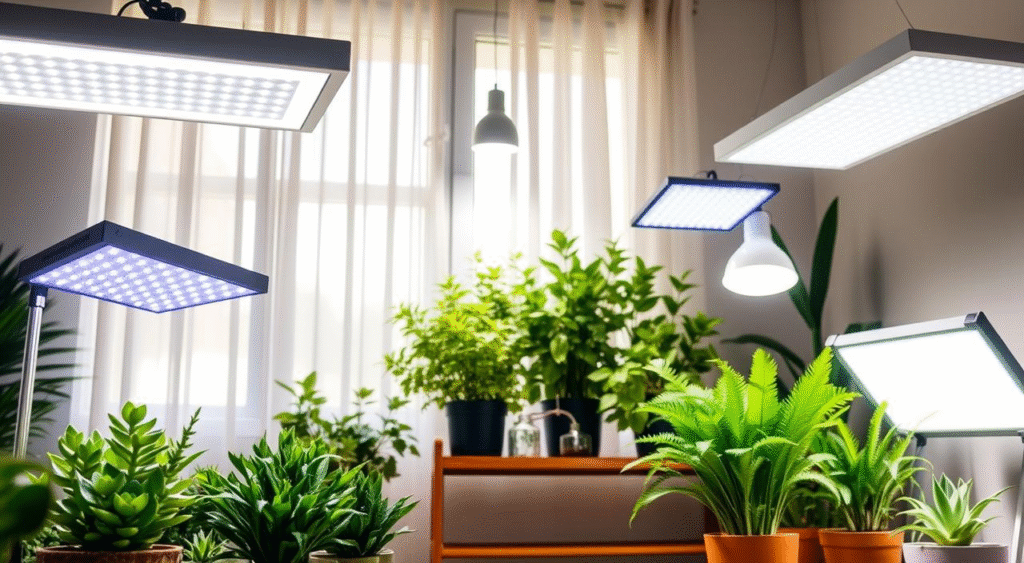
A practical starting distance (then adjust)
- Low-light foliage (ZZ, snake plant, pothos): start 30–45 cm (12–18 in) above canopy.
- Herbs, succulents, high-light plants: start 20–35 cm (8–14 in) above canopy if the fixture isn’t running hot.
Watch the plant for 10–14 days, then adjust:
- Stretchy, leaning, wide gaps between leaves: increase intensity (move closer or run longer).
- Bleaching, crispy spots, curled leaves near the top: reduce intensity (move higher, shorten hours, or diffuse).
If you want a reference point: African violets are commonly grown under artificial light at about 600 foot-candles for roughly 14–16 hours/day in multiple extension publications—useful as a “real-world” benchmark for a flowering houseplant. UF/IFAS UGA Extension
Apartment-friendly mounting ideas
- Under-shelf LED bars: best for plant racks and kitchen herbs.
- Clip-on gooseneck lights: good for one or two pots, but keep them close to avoid wasted light.
- Floor lamp grow lights: best if you want décor-friendly lighting without drilling.
- Wall-mounted rails: best for “living wall” or vertical systems.
Energy Use: How to Estimate Your Monthly Cost (Without Guessing)
Ignore “monthly cost” charts that don’t use your local electricity rate. Use this simple math:
Monthly kWh = (watts ÷ 1000) × hours/day × 30
Monthly cost = monthly kWh × your price per kWh
Example: a 20W LED on 12 hours/day uses (20 ÷ 1000) × 12 × 30 = 7.2 kWh/month. Multiply by your tariff from your electricity bill. LEDs are generally the most energy-efficient option for home use, and the RHS notes they run cool and are efficient compared with other lighting systems. RHS
A Realistic Apartment Example: One Shelf, Six Plants, Zero Fuss
Scenario: A 1-bedroom apartment with one bright window, but a plant shelf sits 2–3 meters away and stays dim most of the day.
- Install a 4000K–6500K LED bar under the shelf above the plants. RHS
- Set a timer to 12–14 hours/day for foliage plants. University of Minnesota Extension
- Keep the bar close enough that the plants aren’t stretching (start ~30 cm above canopy, then adjust).
- Rotate pots weekly so one side doesn’t hog the light.
- In winter, add 1–2 hours/day if you see leggy growth; in summer, reduce hours if the shelf also gets good window light.
This is the kind of setup where grow lights feel “invisible”: the schedule runs itself, and your job becomes simple observation and small adjustments.
Common Problems and Fast Fixes
My plant is growing tall and floppy
That’s usually low intensity. Move the light closer, increase daily hours (within reason), or narrow the lit area so the same light isn’t spread too thin. Low light guidance and placement examples are covered in extension references. Illinois Extension
Leaves are bleaching or getting crispy spots near the top
Too much intensity or too close. Raise the fixture, reduce hours slightly, or add diffusion. The RHS notes intensity can be adjusted by repositioning lights farther from plants or reducing photoperiod. RHS
My timer is “right” but plants still look unhappy
Hours can’t compensate for very weak intensity. If you’re already running 12–14 hours/day and plants stretch, you likely need more light output or better placement. Also confirm you’re not exceeding total light hours when combining window + grow light; many plants need darkness to develop properly. University of Maryland Extension
FAQs
How many lumens do indoor plants need?
Instead of chasing total lumens, aim for intensity at the leaves. Many indoor plant references use foot-candles. As a practical range, low light is often around 25–100 fc, medium-bright 100–500 fc, and high light 500–1000 fc at leaf level. University of Maryland Extension
How many hours a day should I leave grow lights on?
For most foliage houseplants, 12–14 hours/day works well. Flowering houseplants often do well around 14–16 hours/day. Seedlings may use 16–18 hours/day. Use a timer for consistency. University of Minnesota Extension Also avoid pushing total light too high; many plants need a dark period and it’s often recommended not to exceed about 16 hours/day total. University of Maryland Extension
What Kelvin is best for indoor plants?
Kelvin mainly describes how the light looks to you. For an apartment-friendly setup, many growers use white LEDs in the 4000K–6500K range and tune results by distance and hours. The RHS discusses Kelvin values and notes that balancing red and blue light supports growth and flowering. RHS Minnesota Extension also notes that white/balanced bulbs are suitable for most plants at any growth stage. University of Minnesota Extension
How far should grow lights be from plants?
It depends on fixture strength and spread. Start around 30–45 cm (12–18 in) above foliage plants for many small LED fixtures, and adjust based on plant response (stretching = needs more intensity; bleaching = too much). For some plants grown entirely under artificial light, extension references also provide example setups (like African violets at about 12–15 inches from fluorescent tubes). UF/IFAS
Sources and Further Reading
- Royal Horticultural Society (RHS): Artificial lighting for indoor plants
- University of Maryland Extension: Lighting for indoor plants
- University of Missouri Extension: Lighting indoor houseplants
- University of Florida IFAS: Light for houseplants
- University of Minnesota Extension: Lighting for indoor plants and starting seeds
- Illinois Extension: Lighting (houseplants)
- Resource Innovation Institute: PPFD definition and lighting concepts
About the Author
Mohammed Zandar (yup.work90) writes practical indoor plant guides focused on real homes—small spaces, mixed light, and busy schedules—so readers can build routines that work without turning plant care into a full-time job.