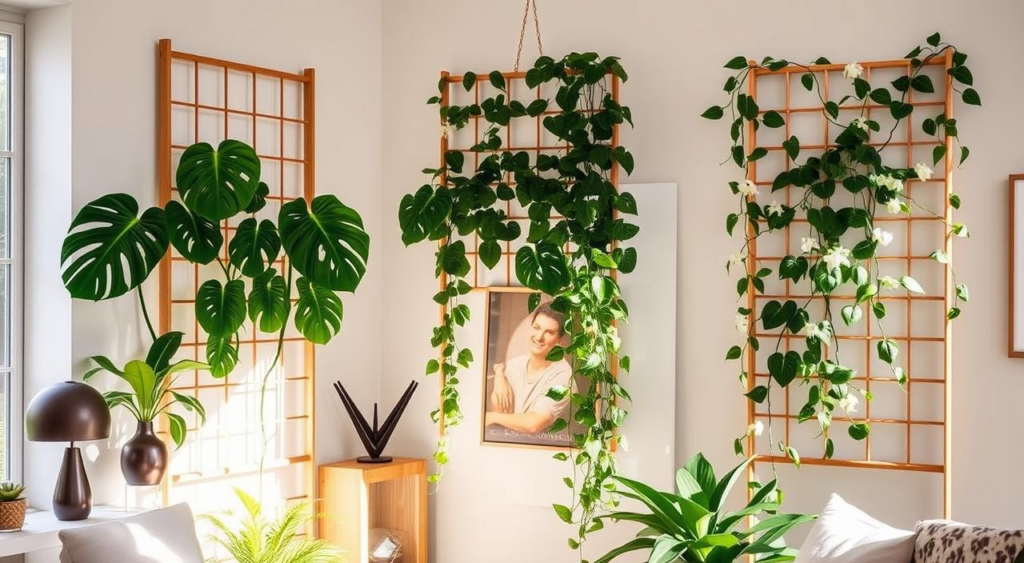
A trailing pothos draped across a bookshelf looks charming at first. Six months later, it’s on the floor, tangled in itself, and taking up space you didn’t plan to give it. Vining houseplants grow fast and they grow sideways unless you give them something to grow up. The good news is that training them vertically is one of the easiest ways to make a small room feel more intentional — and it doesn’t require expensive equipment or complicated setups.
This guide covers the most practical space-saving trellis options for common vining houseplants — Monstera, Pothos, Hoya, and similar climbers — with sizing guidance, plant-specific setups, simple DIY options, and the training habits that keep things looking tidy rather than chaotic.
Quick Answer: The best space-saving indoor plant trellises use vertical wall space or the pot’s existing footprint. Use a wall wire grid for flexible vines like Pothos, a sturdy coir or moss pole for heavy climbers like Monstera, and a compact wire hoop for twining plants like Hoya.
Best for: Indoor plant owners with trailing or climbing plants that are spreading across shelves, floors, or small rooms
Time needed: 10–30 minutes for most simple trellis setups
Main skills: Choosing support type, tying stems loosely, using vertical space, checking growth monthly
Best method: Use wall wires for Pothos, a coir or moss pole for Monstera, and a wire hoop for Hoya
Important: Do not tie stems tightly to a trellis. Vines thicken as they grow, and tight ties can cut into stems over time. Use soft ties and leave a little slack.
Table of contents
- Quick checklist before you buy or build
- Why vining houseplants need support
- What makes a trellis genuinely space-saving
- Best space-saving trellis types
- How to choose the right size
- Plant-specific trellis setups
- DIY trellis options
- Installation and training best practices
- Common mistakes that waste space
- Final Thoughts on Plant Trellises
- FAQs
- Sources and further reading
Quick Checklist Before You Buy or Build
Before choosing a trellis style, run through these four points — they save you from buying something that looks right in a photo but doesn’t work in your actual space:
- Decide on the footprint first. Wall-mounted options and ceiling lines use zero floor space. Pot-insert poles have a small footprint. Freestanding frames take the most room. Your available wall space matters more than the trellis style
- Match the support to the plant’s weight. Heavy plants like Monstera need a stable base and a pole with real depth in the pot. Lighter flexible vines like Pothos are fine on wall wires with occasional ties
- Plan for 6–12 months of growth, not today’s size. A trellis that barely fits the current plant will be outgrown quickly, and repositioning a trained vine is more disruptive than starting with the right size
- Use soft ties and leave slack. Stems thicken over time, and a tie that fits perfectly today can cut into growth in a few months. This is one of the most common training mistakes and one of the easiest to avoid
Why Vining Houseplants Need Support
Most vining houseplants are climbers in nature. They grow toward light, anchor themselves to a surface, and use that support to stay upright as they extend. Without something to climb, they typically do one of two things indoors: trail sideways (which looks fine intentionally, less fine unintentionally) or flop and eventually snap — particularly plants with large, heavy leaves like Monstera.
Monstera deliciosa climbs in its native habitat using aerial roots that grip rough surfaces like bark and moss-covered trunks, which is why textured poles work so well for them indoors. Hoya are tender twining climbers that wrap their stems around a support as they grow — the Royal Horticultural Society notes they’re typically trained onto a wire loop or allowed to trail, depending on the look you want. Pothos sits somewhere in between: perfectly happy trailing, but often able to produce larger, more mature leaves when given enough light and a support to climb.
What Makes a Trellis Genuinely Space-Saving
Not all trellises save space — some just redistribute it. A support is genuinely space-efficient when it does at least one of these things:
- Directs growth upward. Wall grids, wall wires, and tall poles lift the plant vertically rather than letting it spread horizontally across surfaces and floor space
- Keeps the base compact. Pot-insert poles and narrow frame trellises don’t require a wider or heavier pot to function
- Grows with the plant. Modular stackable poles and expandable wall wire systems prevent the plant from outgrowing the support too quickly — which is what leads to the flopping and sprawling you were trying to avoid in the first place
Best Space-Saving Trellis Types
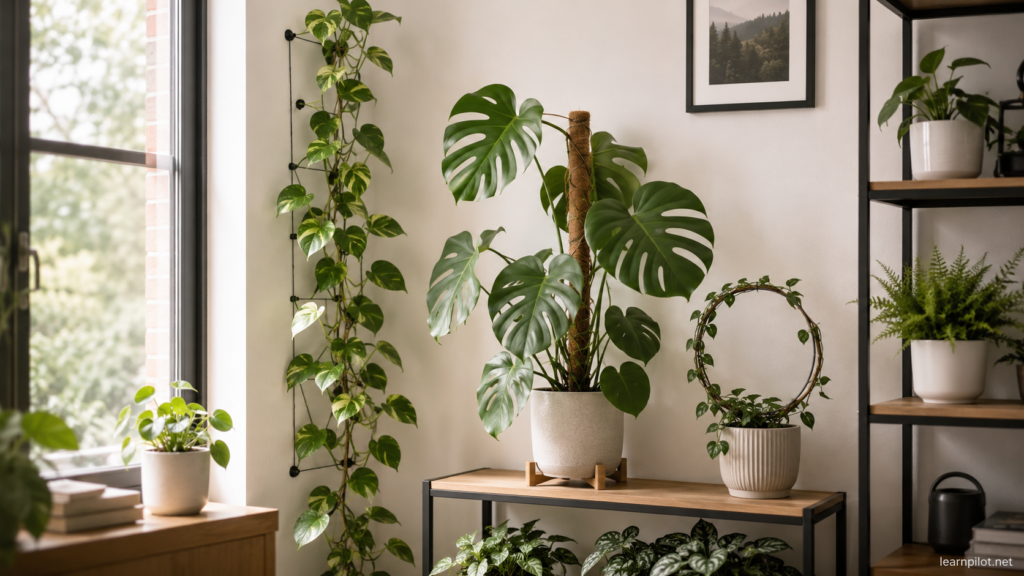
| Trellis type | Best for | Floor space used | Pros | Watch out for |
|---|---|---|---|---|
| Wall-mounted grid (wood or metal) | Pothos, philodendron, lighter vines | Zero | Clean look; easy to expand sideways | Needs proper wall anchors; protect paint behind it |
| Wall wires (horizontal or vertical lines) | Pothos trained flat against a wall | Zero | Minimal and flexible; easy to customise layout | Stems need tying; check ties regularly as vines grow |
| Moss or coir pole (pot-insert) | Monstera, climbing aroids | Small (pot width only) | Aerial roots can attach naturally; good for upright form | Moss poles need moisture; can encourage mould in still, humid air |
| Wire hoop or loop trellis | Hoya and compact twining vines | Small (pot width only) | Perfect for wrap-around training; neat sculptural look | Don’t force stiff vines — train gradually over weeks, not days |
| Ceiling or hanging line | Long trailing vines you want to display up high | Zero | Makes rooms feel taller; dramatic in the right space | Use ceiling anchors rated for the load; keep away from fans and doors |
A note on moss poles specifically: they’re popular because aerial roots genuinely grip them, which helps Monstera produce larger, more mature leaves over time. The practical challenge indoors is that keeping a moss pole consistently moist in a low-airflow room can lead to surface mould. If your home tends to be warm and humid with reasonable air circulation, moss poles work well. If your space is closed up and still, a coir pole or a textured wood trellis is usually a simpler option that requires less maintenance.
How to Choose the Right Size
The two most common sizing errors are choosing a trellis that’s too small (the plant outgrows it and flops anyway) and choosing one so large it dominates the room. These simple rules help avoid both:
- Height: choose a support that’s at least two-thirds of the height you want the plant to reach over the next year — not just its current height. A plant that’s 60 cm now and growing vigorously might reach 120 cm in a year; plan for that
- Stability for heavy plants: if you’re inserting a pole into a pot, the pot should be wide enough that the plant doesn’t tip when you nudge the top growth. A heavy-leaved Monstera on a narrow pole in a small pot is a tipping hazard
- Wall clearance: if training to a wall grid or wires, leave a small gap between the vines and the wall surface. Dense vine growth pressed directly against a wall traps dust and creates sheltered spots where pests establish themselves without being noticed
Plant-Specific Trellis Setups
Monstera: upright support for a big plant in a small space
Best trellis type: a sturdy coir or moss pole inserted into the pot, or a narrow wood trellis if you prefer a firmer support with less maintenance.
The key with Monstera is starting support early — once a stem is set in a particular direction, redirecting it without risking damage becomes harder. Insert the pole deep enough into the potting mix that it doesn’t wobble when the plant gets heavy. Tie stems loosely using soft plant ties, and guide aerial roots gently toward the pole surface. As the aerial roots establish contact and begin gripping, you can reduce the number of ties over time since the roots themselves provide attachment.
Pothos: wall training for maximum coverage with zero floor space
Best trellis type: wall wires or a wall grid for a flat “living wall” effect; a pot-insert pole if you want a single upright column rather than spreading coverage.
Pothos is one of the easiest plants to wall-train because the vines are flexible and respond well to being redirected. For wall coverage, run two to four vertical wire lines and tie stems loosely every 15–25 cm as they grow. For fuller, more even coverage, pin multiple vines upward rather than relying on a single long vine to fill the space. If sections become bare at the base over time — which happens as the plant matures — prune those sections back and use the cuttings to fill gaps by tucking rooted cuttings back into the pot.
Hoya: loop trellis for tidy vines and better display
Best trellis type: a wire hoop or loop is the classic Hoya setup and works well precisely because Hoya are natural twiners — they’ll gradually wrap themselves around the loop with minimal intervention. A small grid trellis works if you prefer straight lines over a circular shape.
The most important thing with Hoya training is patience. The vines can be stiff, and trying to wrap a long section around a hoop in one session risks snapping the stem. Instead, guide a little at a time over several weeks, using soft ties loosely as temporary guides rather than permanent restraints. Keep the newest growing tip free and untied at all times — restricting the tip stops growth.
DIY Trellis Options
If you have an awkward corner, an unusually shaped wall, or just want to avoid buying a trellis that’s slightly the wrong size, building one is often the better option for small spaces. These three builds cover most common situations.
Minimalist wall wires (fastest build)
- Mark two to four vertical lines where you want the vine to climb
- Install wall anchors and hooks rated for the weight — mature vining plants are heavier than they look, and an anchor that pulls out of drywall mid-season is a real problem
- Run coated wire or strong cord between the hooks and pull it taut
- Tie stems loosely to the wires as the plant grows, leaving slack for stem thickening
Ladder trellis for inside a pot
Materials: two bamboo stakes or wood dowels, short cross pieces, and garden twine (or small screws if using wood dowels).
- Build a narrow ladder frame with cross pieces every 10–15 cm
- Insert the legs at the back of the pot so the leaves face outward into the room
- Use soft ties to guide stems upward along the rungs; adjust monthly as growth progresses
Wire hoop for Hoya (best compact footprint)
Materials: thick aluminium wire or coated garden wire, and pliers.
- Bend the wire into a loop slightly wider than your pot — the proportions look better when the hoop is visually balanced with the pot size
- Bend two straight legs at the base and insert them into the potting mix near the rim of the pot
- Guide vine sections around the loop gradually over time; the plant will eventually fill the shape on its own
Installation and Training Best Practices
Start before the plant becomes tangled
The easiest time to add a trellis is before the vines get long and set. Young, flexible stems can be redirected easily. If the plant is already sprawling, you can still train it — but do it in small sessions over a few weeks rather than trying to reposition everything at once. Forcing a stem that’s been growing in one direction for months is how they snap.
Tie correctly from the start
Most indoor climbers won’t hold themselves to a wall or grid without help — tying is a normal, ongoing part of training. The rules are simple: use soft ties (not hard wire directly on stems), leave slack, and check monthly to loosen anything that’s getting tight as stems thicken. One comfortable tie is more useful than three tight ones.
Leave room for airflow
Dense vine growth pressed flat against a wall traps humidity and dust, creating the kind of still, warm microclimate that spider mites and fungus gnats prefer. Leaving a small gap between the foliage and the wall, and occasionally trimming the most crowded sections, keeps airflow moving and makes it much easier to spot pest problems early.
Common Mistakes That Waste Space
- Choosing a trellis that’s too small. The plant outgrows it quickly, then flops and spreads in exactly the directions you were trying to avoid. Size for the plant’s future growth, not its current size
- Using hard wire directly on stems. Bare wire cuts into growth as the stem thickens. Always use soft plant ties, or wrap wire with something soft before it contacts the stem
- Over-wetting a moss pole in a low-airflow room. If the pole stays constantly saturated in a closed, humid room, surface mould follows. Switch to coir or a textured trellis if ventilation is limited
- Mounting wall trellises without proper anchors. Vines accumulate surprising weight over a growing season. A trellis secured only with picture hooks or light wall pins will eventually pull free — use anchors rated for the load, particularly on plaster or drywall
- Forcing stiff vines into tight bends all at once. Stems that have been growing in one direction for a long time are set in that shape. Redirect them gradually over weeks, not in a single session
Final Thoughts on Plant Trellises
The most effective trellis for a small space is usually the simplest one that points growth upward and stays out of the way. For most people with a few common vining plants, that means wall wires for Pothos, a coir or moss pole for Monstera, and a wire hoop for Hoya — none of which require significant investment or complicated installation.
The part that matters most isn’t the trellis type — it’s starting early, tying loosely, and adjusting as the plant grows. A vine that’s been gently guided upward from an early stage is far easier to maintain than one that’s been trailing freely for a year and then needs to be redirected. Get the support in place while the plant is still cooperative, and the rest becomes a simple monthly check rather than a project.
FAQs
Do vining houseplants actually need a trellis, or can they trail?
Trailing is a perfectly valid way to grow most vining plants — hanging pots and shelf edges work well for Pothos, Hoya, and similar plants if that’s the look you want. A trellis becomes important when you want upright growth and a more compact footprint, when a plant like Monstera gets heavy and starts flopping, or when you have more vertical wall space to use than horizontal floor or shelf space. It’s a choice about form as much as function.
Is a moss pole better than a regular trellis for Monstera?
For Monstera specifically, a moss or coir pole has a practical advantage: the aerial roots can physically attach to the textured surface, which is how the plant anchors itself in nature and what tends to encourage larger, more mature leaf development over time. A flat trellis or grid provides support but doesn’t give the aerial roots anything to grip. That said, coir poles are simpler to maintain indoors than moss poles since they don’t need to be kept moist, and they work well for most home conditions.
How often do I need to adjust ties and check the trellis?
A monthly check is usually enough for actively growing plants. Look for ties that are beginning to tighten around thickening stems, any vines that have grown past the support and started heading in an unintended direction, and new growth that needs guiding. During the slower growth of winter, checking every two months is fine. It takes two or three minutes per plant once you get into the habit.
What’s the most space-efficient setup for Pothos?
Wall wires are hard to beat for Pothos in a small space. Two to four vertical lines of coated wire secured with wall anchors, with stems tied loosely every 15–25 cm as they grow, uses zero floor space, can be made exactly as wide or tall as your available wall, and is easy to expand. The main ongoing task is adding a tie every few weeks as new growth extends — it takes about a minute per plant per week during the growing season.
Can I add a trellis to an already established plant, or does it need to be done from the start?
You can absolutely add a trellis to an established plant — it just requires a bit more patience. Stems that have been growing in a particular direction are set in that shape, so redirecting them too quickly risks snapping them. Work in small sessions over two to four weeks: guide a short section at a time, secure it loosely, and let the stem adjust before moving the next section. The more established the plant, the more gradually you need to work — but most vines respond well once you give them time.
What’s the easiest DIY trellis for a beginner with no tools?
Wall wires require the least skill and the fewest materials. You need wall anchors, small hooks or cup hooks, coated wire or strong cord, and a screwdriver. There’s no measuring for precise angles, no cutting materials to exact lengths, and no structural decisions — just hooks in the wall, wire between them, and ties as the plant grows. A basic setup for one wall takes about 15 minutes, and it’s easy to adjust or extend without starting over.
Sources and Further Reading
- Royal Horticultural Society (RHS) – How to tie in climbers
- Royal Horticultural Society (RHS) – Hoya overview
- Gardeners’ World – Tips for training climbing plants
- Gardeners’ World – How to grow Pothos