By Mohammed Zandar (yup.work90)
Last updated: March 5, 2026
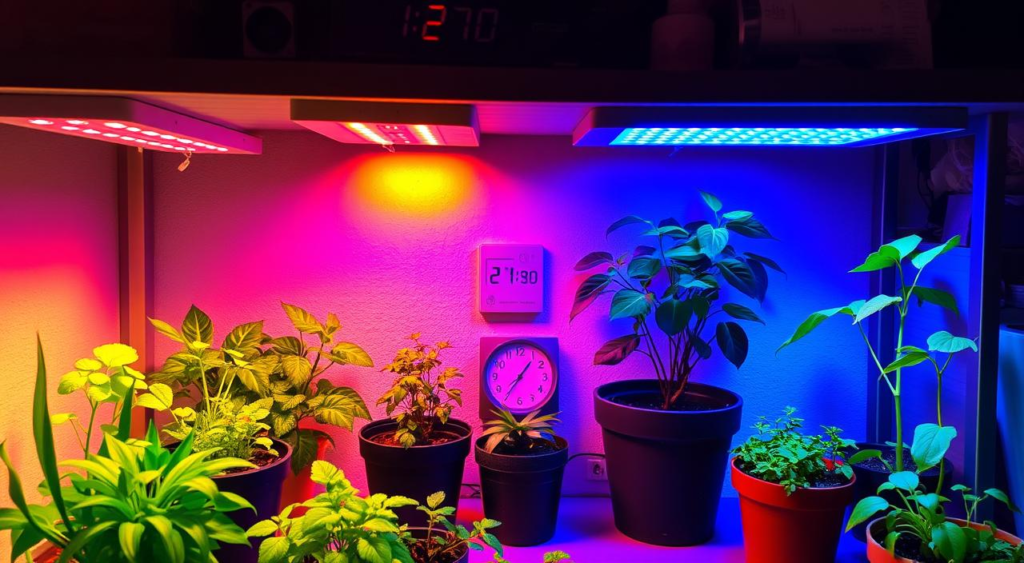
If your plants live on a shelf (not a windowsill), you’re already doing the hard part: giving them a dedicated home. The easy part is making that shelf feel like “daytime” long enough for steady growth. This guide simplifies grow lights for shelf gardens into three things you can actually set: brightness (lumens vs what plants really use), color (Kelvin), and timers (how many hours).
Quick truth that saves money: plants don’t care how bright a light looks to humans. That’s why a “very bright” room lamp often fails, while a modest LED bar can work beautifully when it’s close enough and on a good schedule.
Fast Setup: A Shelf Garden Lighting Baseline (Start Here)
- Pick a “white/balanced” or full-spectrum LED (not a decorative bulb). Mixed/white light works for most plants and looks normal indoors. University of Minnesota Extension
- Set the timer to 14 hours/day as a general starting point for shelf gardens, then adjust. Iowa State University Extension
- Start with safe distances (you can move closer if plants stretch): seedlings 4–6″, herbs 6–12″, foliage plants 12–24″, flowering houseplants 6–12″. University of Minnesota Extension
Then watch for 10–14 days: new growth should be compact, leaves should hold color, and plants shouldn’t lean hard toward the light. If they stretch, move the light closer or run it longer. If leaves bleach or crisp, back it off.
Before Lumens: The 5 Light Terms That Actually Matter
| Term | What it means | Why it matters on shelves |
|---|---|---|
| Lumens | Brightness as humans see it | Useful for rough comparisons, but incomplete for plants. UMN Extension |
| Lux | Lumens per square meter | Better than lumens for “at-leaf” readings, especially with a meter/app. Iowa State Extension |
| PPFD | Plant-usable light hitting leaves (µmol/m²/s) | The best “intensity” number for plants (what leaves receive). Iowa State Extension |
| DLI | Total plant-usable light per day (mol/m²/day) | This is what your timer helps control (intensity × hours). Iowa State Extension |
| Kelvin (K) | Color appearance of white light (warm ↔ cool) | Helps you choose “daylight” vs “warm” white; spectrum still matters most. MSU Extension |
Lumens (Simple Version): Helpful for Shopping, Not for “Plant Math”
Lumens can help you avoid weak bulbs, but they’re a human-eye measurement. University guidance notes that lumens are less relevant for plants because they don’t account for all the wavelengths plants use efficiently. University of Minnesota Extension
What to do in real life (shelf gardener approach):
- If the box lists PPFD (or a PPFD map), use that first.
- If you only see lumens, use them as a rough filter, then rely on distance + timer + plant response (trial and error is a recommended approach for home setups). Iowa State University Extension
- If you want one step better: measure lux at leaf level and convert to PPFD using a manufacturer factor or a trusted table/calculator. Iowa State University Extension
The Metric That Makes Timers Make Sense: DLI (Daily Light Integral)
DLI is simply the total plant-usable light your shelf delivers in a day. It combines intensity (PPFD) with hours. Iowa State University Extension provides a practical home method: measure lux at foliage level, convert to PPFD, then calculate DLI. Iowa State University Extension
The beginner-friendly formulas (no PhD required):
PPFD = lux × conversion factor (depends on the light)
DLI = PPFD × hours × 0.0036 Iowa State University Extension
Target DLI ranges (simple categories): A widely used guideline is low-light plants around 5–10 DLI, medium 10–20, high 20–30, very high 30–50 (mol/m²/day). Oklahoma State University Extension (PDF)
Kelvin Made Simple: Choosing “Warm” vs “Daylight” Without Overthinking
Kelvin is the color temperature of white light: warm (yellow/red) is lower Kelvin, cool (blue/white) is higher Kelvin. MSU Extension notes common ranges like 2700K (warm) up to 6500K (daylight), and many growers mix ends of the range (for example, 2700K + 6500K) to cover more wavelengths. MSU Extension
Practical Kelvin cheat sheet for shelf gardens:
| You’re growing… | Kelvin that’s easy to live with | Why it works |
|---|---|---|
| Seedlings + leafy greens | 5000–6500K (daylight/cool) | Cool/mixed light is commonly recommended for starts and greens. UMN Extension |
| Foliage houseplants (pothos, philodendron, etc.) | 4000–6500K (neutral to daylight) | White/mixed light is suitable for most plants at most stages. UMN Extension |
| Flowering houseplants (general) | 3000–4000K or mixed | Red or mixed light supports bud formation; photoperiod still matters. UMN Extension |
Important note: Kelvin alone doesn’t guarantee plant performance. If you buy a proper grow light with a usable spectrum, intensity (PPFD) + hours (timer) usually matter more than arguing about 4000K vs 5000K.
Timer Settings That Work on Real Shelves (Not Perfect Labs)
Timers are where shelf gardens win: you can “create daylight” every day, even in winter. University of Minnesota Extension gives clear starting photoperiods for indoor setups. University of Minnesota Extension
| Plant group | Good starting timer setting | Notes |
|---|---|---|
| Seedlings | 16–18 hours/day | Raise lights as plants grow to avoid burn. UMN Extension |
| Lettuce + herbs | 12–14 hours/day | Often easiest to manage heat and dryness on shelves. UMN Extension |
| Foliage houseplants | 12–14 hours/day | Great for steady, compact growth. UMN Extension |
| Flowering houseplants | 14–16 hours/day | Some plants need specific night lengths to bloom (short-day vs long-day). UMN Extension |
Don’t break the dark period: For flowering plants, room lights late at night can interrupt the “night” signal and reduce blooms. This is a common indoor mistake, especially with shelves near TVs or kitchens. University of Minnesota Extension
Shelf Layout: Height, Coverage, and “Even Light” Tricks
The best grow light for shelf gardens is the one that lights the entire shelf evenly. Bars and shop-light style fixtures usually beat single bulbs because they reduce hotspots.
Distance guidelines (easy and safe): UMN Extension recommends these starting distances from light to foliage: seedlings 4–6″, hydroponic lettuce/herbs 6–12″, foliage houseplants 12–24″, flowering houseplants 6–12″. University of Minnesota Extension
Three shelf tricks that look “small” but fix most problems:
- Center tall plants, edge short plants so leaves get similar intensity.
- Use white surfaces (white shelf liners, white wall behind shelves) to bounce light back softly.
- Rotate pots weekly to stop leaning and uneven growth.
A “No-Gadget” Way to Dial In Brightness
If you don’t own a PAR meter (most people don’t), Iowa State University Extension recommends a trial-and-error approach: set up lights with general guidelines, observe growth for a few weeks, then adjust distance, number of fixtures, or daily hours based on symptoms. Iowa State University Extension
| What you see | What it usually means | What to do |
|---|---|---|
| Stretching, long gaps between leaves, leaning | Too little intensity | Move light closer, add a bar, or extend hours. Iowa State Extension |
| Bleached patches, scorched edges, unusually tight/compact growth | Too much intensity | Raise the light, reduce hours, or dim if possible. Iowa State Extension |
| Good color but slow growth | Often “okay light” but low DLI | Keep the same height and add 1–2 hours/day, then reassess. |
Energy and Safety Notes (What Most Guides Forget)
Cost math you can reuse:
Monthly cost = (Watts ÷ 1000) × hours/day × 30 × your electricity rate
LEDs typically win long-term because they provide usable plant light efficiently and run cooler than older high-heat systems. Oklahoma State University Extension
- Use a surge protector and keep cords off wet floors (shelves + watering = splashes).
- Create a drip loop in the cord so water can’t run into the outlet.
- Ventilate tight shelves (small clip fan) if leaves stay wet too long after watering or you feel heat building.
Conclusion: The Shelf Garden Sweet Spot
Shelf gardens thrive when you stop chasing “the perfect grow light” and instead control what actually drives growth: distance, hours, and a sensible white/mixed spectrum. Start with 12–14 hours for most foliage plants (16–18 for seedlings), hang the light at a safe distance, then let the plants tell you the rest through their growth. University of Minnesota Extension
If you only remember one thing: move the light before you buy a new light. Shelf gardens are small, and a few inches of height change can completely change results.
About the Author
Mohammed Zandar (yup.work90) writes practical, beginner-friendly indoor gardening guides focused on simple setups that work in real homes—especially shelves, small rooms, and low-light spaces.
Sources
- University of Minnesota Extension: Lighting for indoor plants and starting seeds
- Iowa State University Extension: How to determine how much supplemental light to provide for indoor plants
- Iowa State University Extension: Growing indoor plants under supplemental lights
- Oklahoma State University Extension: LED grow lights for plant production
- Oklahoma State University Extension (PDF): LED Grow Lights for Plant Production (DLI ranges)
- Michigan State University Extension: Transplant production—light considerations (Kelvin examples)