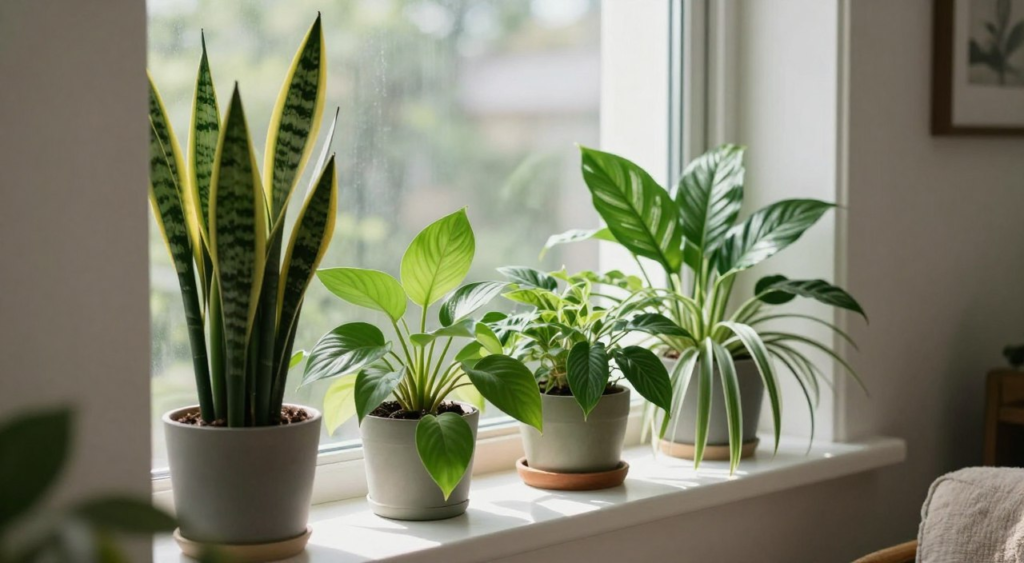
If you’ve stood at a north-facing window and quietly written it off as a dead zone for plants, you’re in good company. It’s one of the most common indoor gardening assumptions — and one of the most worth challenging. North light is real, consistent, and perfectly suited to a whole category of plants that actually prefer it over harsh direct sun.
This guide covers 14 reliable plants for north-facing windows — foliage plants, ferns, and a few that will even flower for you — along with practical tips for understanding your specific window conditions, avoiding the most common beginner mistakes, and keeping everything alive and looking good long-term.
Quick Answer: The best plants for north-facing windows include the Snake Plant, ZZ Plant, Cast Iron Plant, Pothos, and Peace Lily. Because north-facing windows provide gentle, low-intensity light, these plants grow slower and require significantly less water and fertilizer than they would in brighter spots.
Best for: Indoor plant owners with north-facing windows, dim rooms, or gentle indirect light
Time needed: 5–10 minutes to check your window and choose the right plants
Main skills: Reading indoor light, choosing low-light plants, watering less often, avoiding leggy growth
Best method: Start with forgiving plants like snake plant, ZZ plant, cast iron plant, pothos, or Chinese evergreen
Important: Low light does not mean no light. If the spot is too dark to comfortably read during the day without a lamp, even low-light plants may struggle long-term.
Table of contents
- Understanding north-facing windows
- Why north windows are underrated
- 14 plants that thrive in north-facing windows
- Essential care tips for low-light plants
- Common problems and fixes
- Final Thoughts on North Window Plants
- FAQs
- Sources and further reading
Understanding North-Facing Windows
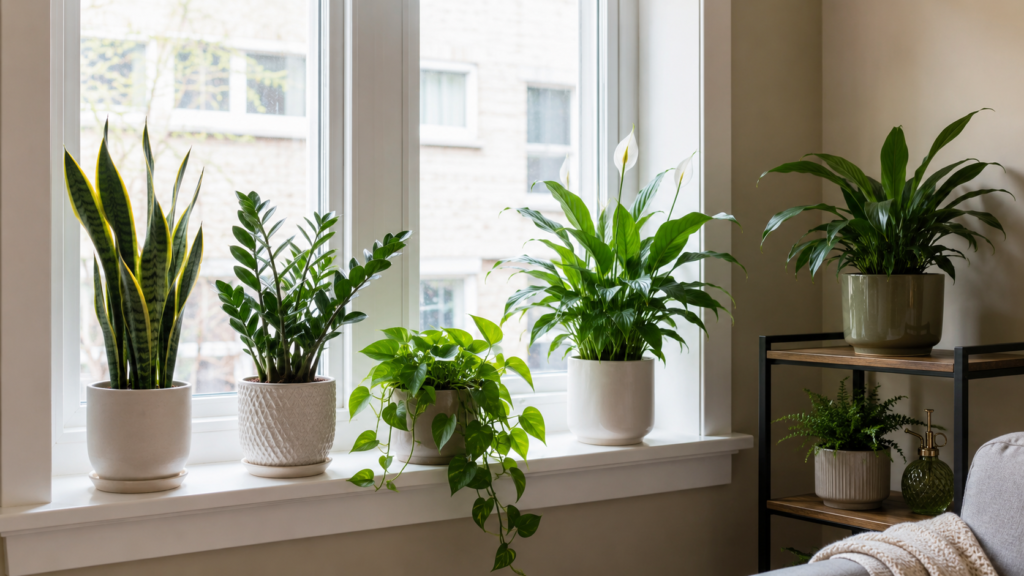
North-facing windows in the Northern Hemisphere receive indirect, lower-intensity light for most of the day. It’s gentle light that rarely scorches leaves, but it can be too dim for sun-loving plants. University of Minnesota Extension places north windows firmly in the “low light” category, while east and west windows typically offer medium light and south windows provide the brightest conditions indoors.
What “low light” actually means in practice
Light labels can feel abstract, so here’s a practical way to think about it:
- Low light: roughly 50–250 foot-candles — common near many north windows
- Medium light: roughly 250–1,000 foot-candles — typical near east or west windows, or in bright rooms
- Bright/high light: 1,000+ foot-candles — usually near unobstructed south-facing glass
These are approximate ranges, not exact thresholds, but they’re more than enough to help you choose plants with confidence.
Is your north window “bright north” or genuinely dim?
Not all north windows are equal. Before choosing plants, check a few things that dramatically affect how much usable light your window delivers:
- Distance from the glass: light levels drop quickly as you move back into a room. A plant sitting 30 cm back from the sill may receive significantly less light than one placed on it
- Obstructions: nearby buildings, overhanging balconies, dense trees, window tinting, or heavy curtains can tip “low light” into “almost no light”
- Season and latitude: winter months can reduce usable daylight hours considerably — if a plant only struggles in winter, a small grow light can bridge the gap without moving it
Why some plants struggle in low light
Plants that need bright light in a dim room often become leggy — long gaps between leaves as they stretch toward the light. They may also lose variegation, stop flowering, or stall entirely. Beyond the visible signs, reduced photosynthesis means the plant uses water more slowly, so soil stays wet for longer. That’s important: it means your watering habits need to adjust too, or root rot becomes a real risk.
Why North Windows Are Underrated
Once you choose the right plants, north windows have real advantages. The light is consistent throughout the day rather than intense and shifting, which means fewer temperature fluctuations and less risk of leaf scorch. Many shade-tolerant plants also have broad, deep-green leaves — evolved to catch whatever light is available — which gives them a naturally bold, lush appearance that suits almost any interior style.
Quick note on air purification: Houseplants can remove some compounds in controlled lab studies, but in real homes, normal ventilation and filtration matter much more. Choose north-window plants mainly for their beauty, mood, and ability to handle gentle light — not because they will dramatically clean the air.
14 Plants That Thrive in North-Facing Windows
Each entry below includes a practical care note for low-light conditions. The first four are the most forgiving starting points if your window is genuinely dim; the rest add variety as you get more comfortable.
Snake Plant (Sansevieria / Dracaena trifasciata)
One of the most reliable low-light plants available, with an upright shape that fits narrow sills and small spaces. Snake plants store water in their leaves, so they handle neglect far better than overwatering.
- Best placement: on the sill or within 1 metre of the window
- Water: let the soil dry out well between waterings — overwatering is the quickest way to lose one
- Good for: beginners, busy schedules, and narrow windowsills
ZZ Plant (Zamioculcas zamiifolia)
Glossy, architectural, and slow-growing — ideal if your window light is truly dim or partially obstructed. The ZZ plant stores water in its thick rhizomes underground, making it exceptionally drought-tolerant.
- Best placement: close to the window, but it can tolerate being further back than most plants
- Water: sparingly — allow the pot to dry most of the way through before watering again
- Watch for: yellowing almost always means too much water in low light, not too little
Chinese Evergreen (Aglaonema)
Boldly patterned leaves and genuine tolerance for low light make this one of the most north-window-friendly plants you can buy. Darker-leaf varieties typically handle lower light better than the brightly variegated ones.
- Best placement: 30 cm to 1.5 metres from the window depending on how bright it is
- Water: moderate — avoid letting soil stay consistently wet
- Tip: if you want colour, choose a darker green or deep red variety for a dim spot
Cast Iron Plant (Aspidistra elatior)
It earned its name. Slow, steady, and genuinely hard to kill in shade — this is the plant for the corner that nothing else seems to survive.
- Best placement: even partially obstructed north windows or dim hallways
- Water: let the top of the soil dry before watering; it dislikes sitting in moisture
- Good for: truly dim rooms, beginners, and anyone who travels frequently
Pothos (Epipremnum aureum)
A great trailing plant for shelves, hanging pots, or training up a small support. Solid green varieties handle lower light better than variegated ones, which need more light to keep their markings.
- Best placement: on the sill for faster growth, or further back for slower but still healthy trailing
- Water: when the top 2–3 cm of soil dries out
- Tip: if you notice the variegation fading to plain green, the plant is asking for more light
Peace Lily (Spathiphyllum)
A reliable foliage plant that will occasionally produce white blooms in a bright north window. It communicates its needs clearly — dramatic drooping when thirsty, then a quick recovery after watering.
- Best placement: close to the window for better flowering; further back for foliage only
- Water: when the top soil begins to dry — don’t wait until it wilts regularly
- Tip: wiping the large leaves occasionally helps them absorb available light more efficiently
Spider Plant (Chlorophytum comosum)
Fast-growing and easy in a bright north window — one of the few plants on this list that will visibly reward you for good care with a steady stream of “baby” offshoots you can propagate.
- Best placement: on the sill or close to the glass
- Water: when the top 2 cm dries; it likes consistent but not soggy conditions
- Bonus: the babies are easy to root in water and make good gifts
Boston Fern (Nephrolepis exaltata)
Ferns can do well in north windows, but they’re more demanding than the plants above. The main requirement is humidity — a dry heated room in winter will quickly turn the fronds brown and crispy.
- Best placement: directly at the window; away from heaters and dry drafts
- Water: keep the soil evenly moist but not waterlogged
- Humidity: a pebble tray with water underneath the pot helps in dry rooms
Bird’s Nest Fern (Asplenium nidus)
A fern with a bold, sculptural shape that handles shade better than most. The wide, undivided fronds look striking and cope well with lower humidity than a Boston fern.
- Best placement: close to the window for thicker, wider fronds
- Water: keep lightly moist; avoid pouring water directly into the central “nest” where fronds emerge
- Tip: more forgiving of typical home humidity than most ferns
Prayer Plant (Maranta leuconeura)
Beautifully patterned leaves that fold upward in the evening like hands in prayer — one of the more characterful plants on this list. It does well in a north window as long as watering stays consistent.
- Best placement: bright north window or slightly set back from the glass
- Water: likes consistent moisture — don’t let it dry out completely
- Tip: crispy leaf edges usually mean low humidity or irregular watering rather than a light problem
Begonia (shade-tolerant varieties)
Many begonias — particularly rex and rhizomatous types — actually prefer bright indirect light over direct sun, which makes a north window close to ideal. If a begonia starts stretching toward the glass, it’s simply asking to move closer.
- Best placement: on the sill for strongest colour and compact growth
- Water: allow the top of the soil to dry slightly between waterings; wet soil causes root problems quickly
- Tip: leggy, reaching growth is a sign it needs to be closer to the glass
African Violet (Saintpaulia)
A reliable bloomer for bright north windows — if the window is clear and unobstructed, African violets can flower for much of the year. They’re fussier than foliage plants, but the regular blooms make the extra attention worthwhile.
- Best placement: as close to a bright north window as possible; consider a small grow light if it refuses to bloom
- Water: keep leaves dry — bottom watering is popular to avoid water sitting on the crown and causing rot
- Tip: consistent warmth and steady light are more important for blooming than any fertilizer
Christmas Cactus (Schlumbergera)
Unlike desert cacti, the Christmas cactus is a forest plant that genuinely prefers bright, indirect light — making it a good match for a clear north window. Cooler nights and longer periods of darkness in autumn naturally help trigger flowering.
- Best placement: near the window but away from cold draughts or direct heating
- Water: more often than desert cacti; allow the soil to partially dry between waterings
- Bloom note: if it doesn’t flower, try giving it cooler nights and uninterrupted darkness for several weeks in autumn
Moth Orchid (Phalaenopsis)
Phalaenopsis orchids are among the more achievable flowering plants for north windows because they actively dislike direct sun. A bright, unobstructed north window with no buildings or trees blocking the light can work well.
- Best placement: directly on the sill of a bright north window; try an east window if flowering is persistently weak
- Water: soak and drain thoroughly; never leave roots sitting in water in the decorative pot
- Tip: if yours hasn’t bloomed in over a year, the most likely cause is insufficient light — not “bad luck”
Essential Care Tips for Low-Light Plants
Something that took a while to click when starting out with north-window plants: the care habits that work brilliantly near a bright window can slowly kill the same plant in a dim one. Low light changes how plants use both water and nutrients, and adjusting for that makes the difference between a plant that thrives and one that just slowly declines.
Water less often than you think you should
This is the single most important adjustment for north-window plants. In low light, growth slows and the plant uses water more slowly — which means soil stays wet for longer after each watering. Always check the soil before watering: insert a finger about 2–3 cm into the mix. If it still feels damp, wait. Most overwatering problems in north windows come from continuing a bright-window watering schedule in a much dimmer spot.
Fertilise lightly in low light
In low light, plants grow slowly and process nutrients slowly too. Over-fertilising a slow-growing plant can cause salt buildup in the soil and burn roots. Feed lightly in spring and summer with a diluted dose, then reduce or pause entirely in autumn and winter unless you’re supplementing with a grow light that’s actively increasing growth.
Rotate pots regularly
Plants lean toward their light source, and in a north window that light is already limited. Rotating pots by a quarter turn every week or two encourages more even, upright growth and prevents one side of the plant from becoming dense while the other stretches and thins out.
When a small grow light makes sense
If you notice persistent legginess, a flowering plant that refuses to bloom, or significant decline in winter, a small LED grow light on a timer is often the simplest fix. It doesn’t need to be elaborate — even a basic clip-on grow bulb running for 8–10 hours a day can meaningfully improve conditions for the plants directly below it.
Common Problems and Fixes
Leggy, stretched growth
Leggy growth — long gaps between leaves, a plant leaning or reaching toward the window — is almost always a light problem first. Move the plant closer to the glass, clean the window glass if it’s dirty or dusty, rotate it, or add a small grow light. Pruning back stretched stems can improve the plant’s shape while you address the underlying cause.
Yellowing leaves
In north windows, yellowing is more often a watering issue than a light issue. Soil staying wet for too long in low light is the most common cause. Check that the pot drains freely, remove any standing water from saucers, and let the soil dry more thoroughly before the next watering. If the pot has no drainage hole, that’s the first thing to address.
Pests in low-light corners
Slower-growing plants in dim corners can be more vulnerable to pests settling in because there’s less vigorous new growth to outpace the problem. Check leaf undersides weekly, especially on ferns and prayer plants. Catching an infestation early — when you see a few insects rather than a colony — means a simple treatment like insecticidal soap or neem oil solution is usually enough.
When a plant simply isn’t working
If a plant has been declining steadily for two or three months despite careful watering and regular rotation, treat it as a light mismatch rather than a care failure. Move it to a brighter spot and replace it with one of the tougher north-window options — ZZ plant, snake plant, cast iron plant, or aglaonema will all handle the conditions more reliably.
Final Thoughts on North Window Plants
North-facing windows aren’t a limitation — they’re a specific set of conditions that suit a specific group of plants very well. Start with the most forgiving options: ZZ plant, snake plant, cast iron plant, and Chinese evergreen are genuinely hard to get wrong. From there, add texture with ferns and prayer plants, then try the bloomers — peace lily, African violet, Christmas cactus, and Phalaenopsis orchid — once you understand how bright your window actually is.
If you keep one principle in mind above everything else: water less often in low light. Most problems that north-window plant owners run into begin not with the light, but with soil that stays wet for too long in a room where the plant is barely growing.
FAQs
Are north-facing windows always low light?
Usually, but not always. A large, unobstructed north window with light-coloured walls nearby and no buildings or trees blocking the sky can qualify as “bright north” — noticeably better than a small window set into a thick wall with a building directly opposite. University of Minnesota Extension has a good practical overview of indoor light levels and how window direction affects them. Use your plant’s behaviour as the final guide: consistent stretching toward the glass means it needs more light.
Which plants are easiest to start with in a north window?
Snake plant, ZZ plant, Chinese evergreen, and cast iron plant are the four most forgiving options for genuinely low light. All four tolerate irregular watering, handle dim conditions without visible decline, and recover well from beginner mistakes. Start with one of these before moving to ferns or flowering plants.
Can flowering plants really bloom in a north-facing window?
Some can, yes. Peace lily, African violet, Christmas cactus, and Phalaenopsis orchid can all bloom in a bright north window — particularly if the window is large and unobstructed. If a plant produces foliage but no flowers, moving it slightly closer to the glass, cleaning the window, or adding a small grow light usually resolves it. Weak or absent flowering in these plants is almost always a light issue rather than anything more complicated.
Do north-window plants need fertiliser?
Yes, but less than bright-window plants. In low light, growth is slower and the plant processes nutrients more slowly too. A light application of a balanced liquid fertiliser in spring and summer — at half the recommended dose or less — is usually enough. Avoid fertilising in autumn and winter unless you’re supplementing with a grow light, as unused fertiliser salts build up in the soil and can damage roots over time.
Do houseplants actually improve air quality?
In controlled lab settings, yes — certain plants can remove some volatile organic compounds from the air, as shown in the original NASA research. However, a detailed review by Cummings and Waring found that in real homes with normal ventilation and air exchange, you would need an unrealistically large number of plants to match what typical building airflow already does. Plants are genuinely good for wellbeing and make a room feel better to be in — but for air quality, ventilation and filtration are the more effective tools.
Why do my north-window plants keep getting yellow leaves?
In most cases, the cause is overwatering rather than insufficient light. In a dim room, the plant grows slowly and uses water slowly — so soil that would dry out in four or five days near a bright window might still be wet after two weeks in a north corner. Check that your pot drains properly, empty the saucer after watering, and let the soil dry more thoroughly before watering again. If yellowing persists after correcting watering habits, check the roots for signs of rot.
Sources and Further Reading
- University of Minnesota Extension – Growing indoor plants in low light
- NASA Technical Reports Server – Interior Landscape Plants for Indoor Air Pollution Abatement
- Cummings & Waring – Potted plants do not improve indoor air quality: a review and analysis (Journal of Exposure Science & Environmental Epidemiology)
- Missouri Botanical Garden – Dracaena trifasciata
- University of Wisconsin-Madison Extension – Pothos