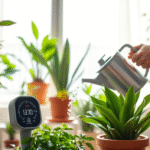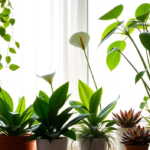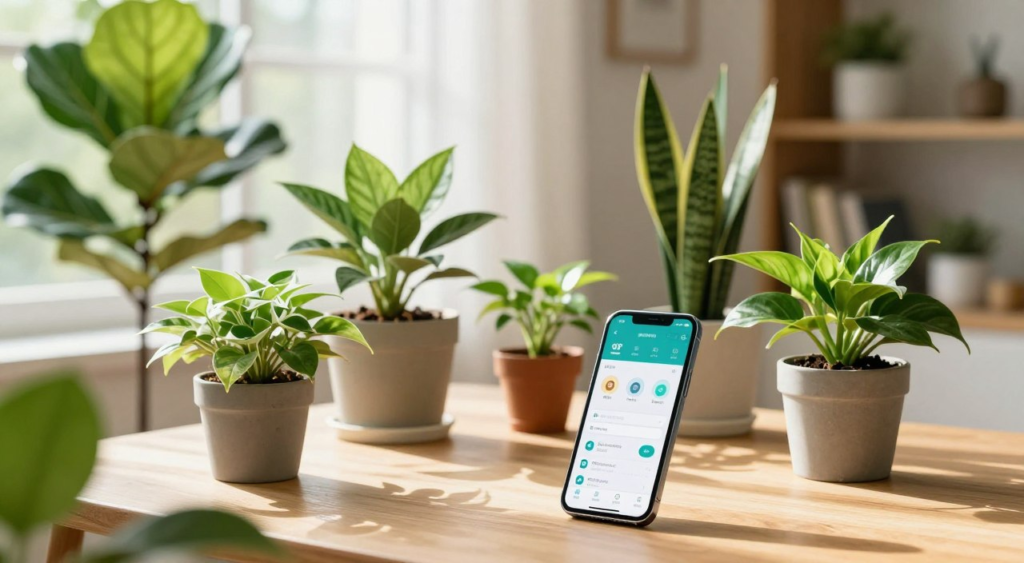
You place a plant near what feels like a bright spot, and a few weeks later it’s stretching toward the window with long gaps between leaves — telling you in the only language it has that the light isn’t enough. The problem is that human eyes adapt to dim conditions automatically. What feels comfortably bright to you might be genuinely low light for a plant. Measuring it, even roughly, removes that guesswork entirely.
Quick Answer: You can use a free lux meter app on your smartphone to estimate indoor plant light. Hold your phone at the plant’s leaf level, face the sensor toward the window, and take readings at more than one time of day. Most tropical foliage plants do well in medium light, roughly 2,000 to 5,000 lux or 200 to 500 foot-candles.
Best for: Indoor plant owners who are unsure whether a room is low, medium, or bright indirect light
Time needed: 5 minutes for a quick check, 15–20 minutes to map several plant spots
Main skills: Using a lux meter app, measuring at leaf level, comparing room spots, adjusting plant placement
Best method: Use the same phone, same app, and same measuring angle each time so your readings stay consistent
Important: Phone light readings are estimates, not laboratory measurements. Use them mainly to compare spots in your own home, not as perfect scientific numbers.
Your phone can help with this — not with lab-grade precision, but accurately enough to compare spots in your home and make better placement decisions. This guide walks you through a simple calibration routine, how to read and interpret the numbers, how to build a quick light map of your rooms, and what to do with the results.
Table of contents
- Quick calibration in 5 minutes
- What your phone measures — and what it doesn’t
- Lux and foot-candles: the only conversion you need
- How to measure indoor light with your phone
- Building a simple light map of your home
- Interpreting results: low, medium, and high light
- Mistakes that make phone readings unreliable
- What to do after you measure
- Choosing a light meter app
- Final Thoughts on Light Measurement
- FAQs
- Sources and further reading
Quick Calibration in 5 Minutes
Smartphone light sensors are designed for screen auto-brightness, not scientific measurement, so accuracy varies by phone model and app. That’s fine — the goal isn’t a perfect lux number. The goal is a consistent comparison system that works reliably across your own home. Here’s how to set that up before you start measuring.
- Clean the sensor area. Wipe the front of your phone, especially around the ambient light sensor (usually near the front camera). Even a thin layer of dust can skew readings
- Disable anything that interferes. Close camera apps and any night mode or blue light filter tools running in the background — these can affect how the sensor reads light
- Pick one unit and stick to it. Use lux if your app supports it (most do). Convert to foot-candles only if a plant guide you’re referencing uses them — see the conversion section below
- Take a baseline reading at your brightest window. Position the phone at leaf level near your clearest window at midday, take a reading, and record it. Then take a reading from the centre of the same room. Save both numbers. These become your home’s reference points for everything else
- Use a diffuser if your app recommends one. Some apps (notably Photone) suggest placing a small piece of white paper over the sensor for more accurate readings on certain devices. Follow the in-app guidance if it’s provided — it genuinely improves consistency
The target isn’t perfect accuracy. It’s a reliable system for comparing spots in your specific home so you can stop guessing where “bright indirect” actually falls.
What Your Phone Measures — and What It Doesn’t
Most light meter apps estimate illuminance — the brightness of light as perceived by human eyes, measured in lux or foot-candles. Plants, however, care about something slightly different: photons in the photosynthetically active radiation (PAR) range, roughly 400–700 nm of the light spectrum. This is often measured as PPFD (micromoles of photons per square metre per second). Some advanced apps estimate PPFD, but results vary significantly depending on your phone’s sensor quality, calibration, and diffuser setup.
| Measurement | What it tells you | Best use at home |
|---|---|---|
| Lux | Brightness, weighted to human vision | Comparing plant placement spots; building a light map of your rooms |
| Foot-candles (fc) | Same concept as lux, different unit | Matching older plant care guides that use fc rather than lux |
| PPFD | Photon intensity relevant to photosynthesis | Optimising grow lights for shelves or seedlings — most useful with a dedicated quantum sensor meter |
For most plant placement decisions using natural window light, lux and foot-candles are sufficient. PPFD becomes more important when you’re relying heavily on grow lights and need to dial in exact intensities.
Lux and Foot-Candles: The Only Conversion You Need
Many plant care guides — especially older American ones — use foot-candles. Most phone apps show lux. The conversion is straightforward:
- To convert lux to foot-candles: divide by 10.764
- To convert foot-candles to lux: multiply by 10.764
In practice, dividing by 10 is close enough for plant care purposes. A reading of 5,000 lux is approximately 500 foot-candles. You don’t need to be more precise than that for home placement decisions.
How to Measure Indoor Light with Your Phone
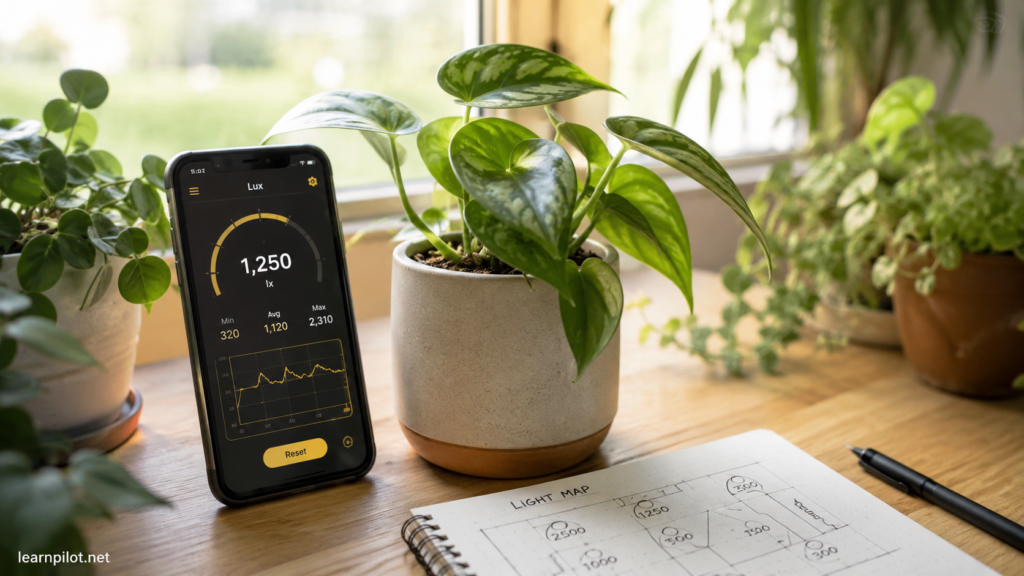
The readings only mean something if you take them consistently. Varying the position, angle, or time of day between measurements makes comparisons unreliable. Here’s a repeatable routine that gives results you can actually use:
- Measure at leaf level. Hold the phone where the leaves actually sit — not on the floor, not on the windowsill. The light the plant receives is what matters, and it can differ considerably from what’s happening at a different height
- Face the sensor toward the light source. For window light, aim toward the window. Some apps want the sensor facing directly upward — follow your app’s guidance if it specifies
- Step to the side. Your body casts a shadow. Even a partial shadow over the sensor can drop a reading by hundreds of lux, so position yourself so you’re not blocking the light while measuring
- Take three readings per spot. Left side of the pot, centre, and right side. Average them, or just record the middle value if you’re working quickly. A single reading from one angle can be misleading
- Measure at two times of day. Late morning and mid-afternoon gives a more complete picture than a single snapshot, particularly for south or west-facing rooms where light quality changes significantly through the day
Building a Simple Light Map of Your Home
Do this once and plant placement becomes dramatically easier — and you stop second-guessing yourself every time you move something. Pick five to eight common plant spots in your home and fill in the readings below. The centre-of-room entry is often the most surprising: spaces that feel comfortably bright to us are frequently in the low-light range for plants.
| Spot | Morning lux | Afternoon lux | Notes |
|---|---|---|---|
| Brightest window (at leaf level) | ____ | ____ | Direct sun? Sheer curtain? Facing which direction? |
| 1 metre back from window | ____ | ____ | Good test for “bright indirect” conditions |
| Centre of room | ____ | ____ | Often much darker than it looks |
| Plant shelf (note height) | ____ | ____ | Top vs lower shelf can differ significantly |
| Bathroom or hallway | ____ | ____ | Low-light plant candidates only |
Once this is filled in, you can match a plant’s light requirements to an actual spot with real numbers rather than guessing from labels like “bright indirect” — which means something different in every home.
Interpreting Results: Low, Medium, and High Light
Different sources define these categories slightly differently, and that’s fine — they’re guidelines, not rigid thresholds. The ranges below are appropriate for typical window light situations and work well for most common houseplants. Use them as starting points, then watch how the plant behaves over two to three weeks and adjust from there. University of Maryland Extension has useful background reading on indoor light terms and typical window ranges.
| Category | Foot-candles | Approximate lux | Plants that generally cope well |
|---|---|---|---|
| Low light | 25–200 fc | 270–2,150 lux | Snake plant, ZZ plant, cast iron plant, most pothos varieties (growth will be slower) |
| Medium light | 200–500 fc | 2,150–5,380 lux | Peace lily, philodendron, dracaena, Chinese evergreen |
| High light | 500+ fc | 5,380+ lux | Most succulents and cacti, many flowering plants — requires gradual acclimation |
Important: the numbers are a starting point. A plant in the “correct” lux range for its category can still struggle if other factors — pot size, soil drainage, humidity, temperature — are off. Light measurement removes one variable; it doesn’t remove all of them.
Mistakes That Make Phone Readings Unreliable
These come up regularly and are worth naming specifically, because they’re the difference between measurements you can act on and numbers that actively mislead you.
- Measuring only at midday once. Your plant lives in that spot all day. A single noon reading in summer misses the full picture, especially in rooms where morning and afternoon light differ significantly
- Measuring at the window but placing the plant 2–3 metres back. Light drops quickly as you move away from the glass. A window reading may show 8,000 lux; the actual plant position two metres away might be under 1,000
- Switching apps partway through. Different apps and different phone models produce different readings. Pick one combination and use it consistently for all your comparisons
- Ignoring curtains and room reflections. A sheer curtain can reduce light intensity by 30–50%. Conversely, white walls and light-coloured floors bounce light into a room in ways that improve conditions noticeably — and neither effect shows up in a window-only measurement
- Not acclimating plants when moving them. Even if the new position is technically “correct” for that plant, moving it abruptly from low to high light can scorch leaves. Increase light exposure gradually over one to two weeks, especially in summer
What to Do After You Measure
The measurement is only useful if it leads to a clear action. For each plant, pick one thing to try based on the reading:
- If light is too low: move the plant closer to the window, raise it on a stand to get it above any low furniture blocking the light path, or relocate it to a brighter room. If none of those options are practical, a small LED grow light running for 10–14 hours per day makes a meaningful difference for most foliage plants
- If light is too high: pull the plant back from the glass, add a sheer curtain to diffuse intensity, or move it to an east-facing window where morning sun is gentler than afternoon western exposure
- If light is uneven across the pot: rotate the pot a quarter turn each week so all sides receive roughly equal light and growth stays balanced
If you’re supplementing with grow lights and want to understand PPFD and daily light integral (DLI) concepts more deeply, Michigan State University Extension has a detailed technical overview on quantum sensors and light measurement in plant environments.
Choosing a Light Meter App
The specific app matters less than using it consistently. What to look for: an app that shows lux, lets you log or save readings, and explains clearly how to hold the phone for measurement. If it offers calibration guidance or diffuser instructions, follow them — they’re there because sensor accuracy genuinely varies across devices.
Photone is widely used and offers both lux and PPFD measurement depending on your device and setup. For straightforward placement mapping, any well-reviewed “Lux Meter” app with a clean interface will do the job.
A note on accuracy expectations: a review published via NIH/PMC on smartphone light sensors and illuminance measurement confirms that sensor quality varies considerably across phone models. This is why consistent method matters more than the specific app — the comparison between two spots measured the same way on the same phone is reliable even when the absolute values may be off.
Final Thoughts on Light Measurement
Measuring light with your phone won’t turn you into a horticulturalist, but it will stop you from making placement decisions based purely on how a room feels. That alone solves a large percentage of slow-decline plant problems — the kind where nothing obviously goes wrong, but the plant just gradually gets worse.
The practical takeaway: do the five-minute calibration once, build a light map of your key plant spots, and check readings again when seasons change or furniture moves. After a couple of rounds, you’ll have a genuinely useful picture of how light moves through your home throughout the year — and plant placement will start feeling a lot less like guesswork.
FAQs
Can I trust my phone’s lux readings exactly?
Treat them as estimates rather than precise measurements. The real value of a phone light meter is comparing one spot to another in your own home using the same device and method — not producing numbers that match a laboratory instrument. Relative comparisons are reliable and genuinely useful for plant placement decisions; absolute accuracy against a calibrated meter is not something to expect from a smartphone app.
Should I measure in lux or foot-candles?
Lux is fine for most purposes and is the default unit in the majority of light meter apps. Convert to foot-candles only if the plant guide you’re using references fc rather than lux — divide your lux reading by 10 for a close enough approximation. There’s no practical advantage to working in foot-candles otherwise.
Do I need PPFD measurements for houseplants?
Not usually. Lux and foot-candles are sufficient for making window placement decisions for almost all common houseplants. PPFD becomes relevant when you’re relying heavily on grow lights and want to optimise intensity precisely — for example, calibrating a shelf setup for seedlings or fast-growing tropicals. For most home growers using natural window light, lux measurements are more than adequate.
Why does my reading change when I tilt the phone?
The light sensor receives different amounts of light depending on the angle it’s facing, which is why consistent orientation matters. Choose one method — sensor facing the window, or sensor facing up — and use it for every measurement. Taking three readings per spot and averaging them also helps smooth out small variations from positioning.
How often should I re-check my home’s light levels?
At minimum, when seasons change — the difference between a winter and summer reading at the same window can be dramatic, particularly in higher latitudes where the sun’s angle shifts considerably. Also re-check any time you move furniture, add or remove curtains, or notice plant symptoms like stretching, pale foliage, or new growth that’s noticeably smaller than the established leaves. Those visual cues often signal that light conditions have shifted from what they were when you last measured.
My app shows a high reading but my plant is still stretching — why?
A few possible reasons. First, check where the reading was taken — if you measured at the window but the plant is sitting 1–2 metres back, the actual light at leaf level may be much lower than the window reading suggests. Second, duration matters as well as intensity: a plant that receives strong light for two hours but is otherwise in deep shadow may still not be getting enough total light through the day. Third, some plants have high light requirements that a north or east window simply can’t meet regardless of the reading — they need a south window or supplemental grow lighting to stay compact and healthy.
Sources and Further Reading
- University of Maryland Extension – Lighting for indoor plants
- Michigan State University Extension – Quantum sensors, PPFD, and light measurement
- NIH/PMC – Smartphone light sensors and illuminance measurement (peer-reviewed review)